
Polyvinyl chloride (PVC) has long been valued across industries for its cost‑effectiveness, flame retardancy, electrical insulation, and chemical resistance. However, virgin PVC suffers from inherent limitations: low impact strength, poor thermal stability during processing, and inadequate low‑temperature flexibility. To overcome these constraints, thermoplastic polyurethane (TPU) has emerged as one of the most effective modifiers for PVC, creating **polymer blends** that combine complementary attributes of both materials.
1. Enhanced Mechanical Performance
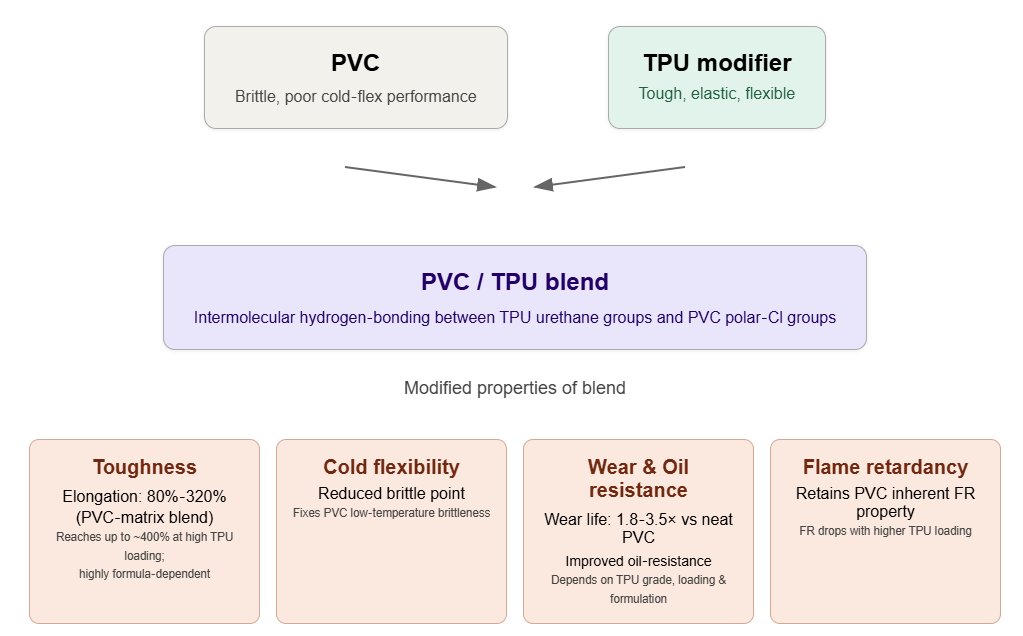
TPU itself is well‑known for high modulus, excellent tear strength, and high elongation‑at‑break; certain neat TPU grades can exceed 600%. When blended with PVC as a toughening modifier, TPU improves the ductility of PVC‑matrix compounds. Research demonstrates that PVC/TPU blends achieve good compatibility through intermolecular hydrogen‑bonding interactions between TPU urethane groups and PVC polar C‑Cl groups, delivering homogeneous phase morphology and substantially improved tensile properties.
For industrial PVC‑matrix blends (TPU loading 20‑45 phr), typical elongation ranges 80%‑320%. Elongation may approach ~400% only at very high TPU fraction near phase inversion; mechanical performance is strongly formulation‑dependent.
2. Low‑Temperature Flexibility
One of the most compelling reasons to modify PVC with TPU is the dramatic improvement in cold‑resistance. TPU can substantially reduce the brittle‑point temperature of PVC, enabling service in environments where unmodified PVC would crack or fail.
3. Superior Oil and Abrasion Resistance
PVC‑TPU blends exhibit improved oil resistance; volume‑and‑weight change (ΔV, ΔW) in oil immersion can generally remain below 0.5 % for properly formulated grades.
Neat TPU possesses high abrasion resistance versus natural rubber, but this benchmark cannot be directly applied to PVC‑TPU blends. For PVC‑continuous‑phase blends, wear‑life improvement versus neat PVC typically falls within **1.8‑3.5×**, varying with TPU grade, loading, filler content and processing conditions.
4. Synergistic Property Balance
Modification delivers complementary rather than purely one‑directional property trade‑offs. While TPU boosts PVC’s flexibility, toughness and low‑temperature performance, PVC brings cost advantages and retains its inherent flame‑retardant character to the blend.
> Important note:Neat‑PVC has better flame retardancy than neat‑TPU. When TPU is added into a PVC‑matrix system, the blend preserves PVC‑originated flame retardancy, but LOI will gradually decrease as TPU loading increases.
Only in TPU‑rich systems where TPU is the continuous phase can incorporating PVC enhance the overall flame retardancy.
5. Reduced Plasticizer Dependency
Traditional flexible PVC relies heavily on phthalate‑based plasticizers, which face growing regulatory restrictions and are prone to migration over time, resulting in progressive brittleness. TPU modification provides an internal‑plasticization effect without plasticizer migration risk, offering a more durable and regulatory‑compliant material solution.
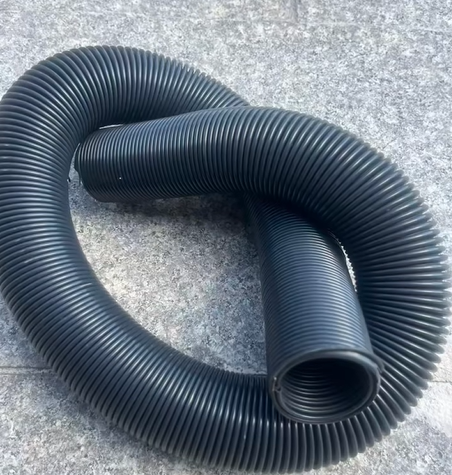
If 당신은 우리의 제품에 관심이 있고 자세한 내용을 알고 싶다면 여기에 메시지를 남겨주세요, 우리는 가능한 한 빨리 회신 해 드리겠습니다.


 IPv6 네트워크 지원