TPU vs. TPEE Shoe Shanks: An Honest Comparison — and Why TPU Remains the Smart Choice for Most Footwear Brands
If you've ever compared shank or support-plate options with a footwear material supplier, TPU and TPEE almost always come up as a pair. They get compared constantly — and for good reason: they're close cousins in the "moldable elastomer" family, and both show up across the same product categories. But they behave differently enough under load that picking the wrong one — or the wrong grade within a family — can mean a shank that either goes soft too soon or feels too stiff for the shoe it's in.
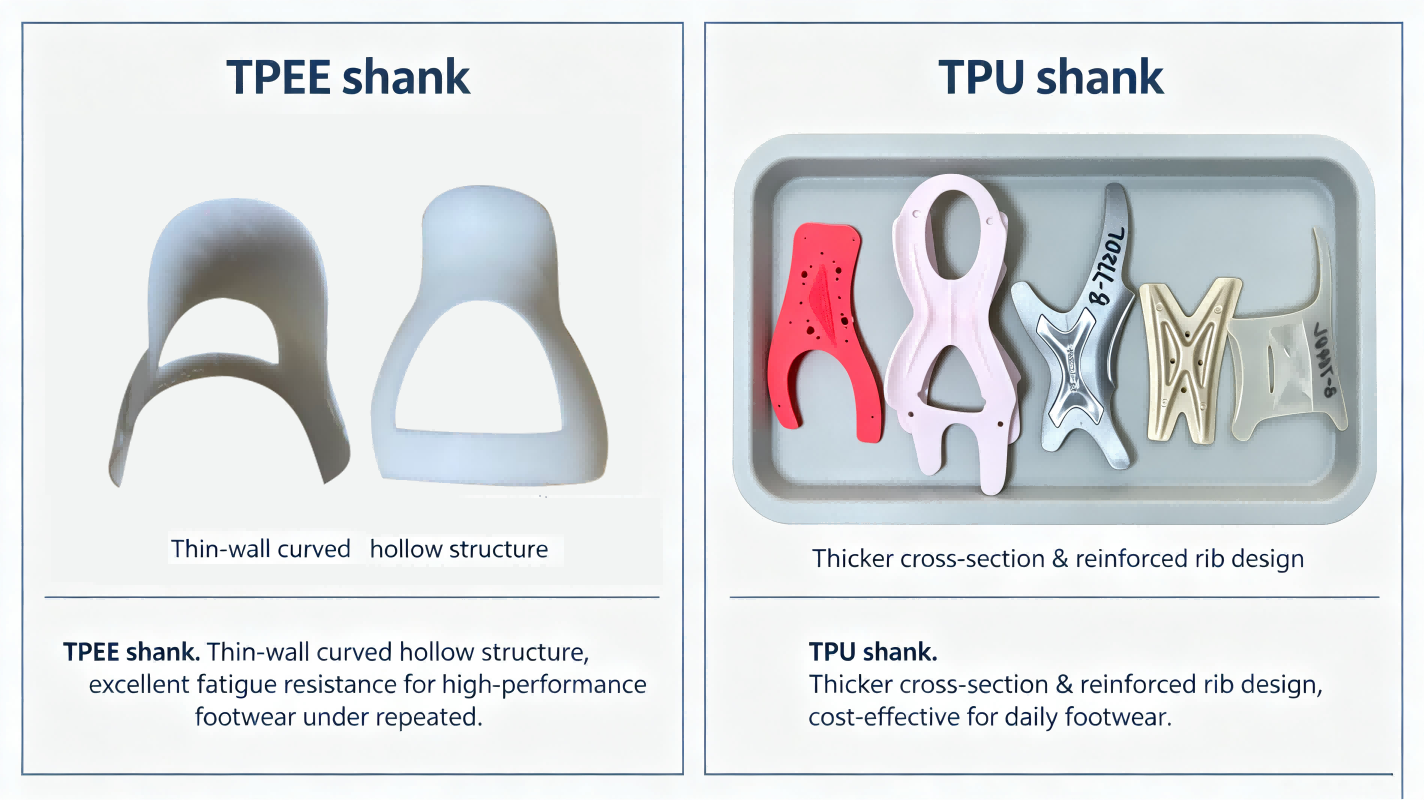
As a manufacturer that specializes in TPU, we at KUNSUN spend a lot of time helping footwear brands work through exactly this decision. Here's how the two materials actually stack up — and where TPU, correctly specified, wins more often than the comparison tables suggest.
What They Have in Common
-
Both are thermoplastic elastomers — injection moldable, extrudable, reprocessable, with no rubber-style curing step.
-
Both are measured on the Shore hardness scale. TPEE shank grades typically sit on the D scale (roughly D32–D82), while TPU shanks more often run in the A80–A95 range or low-D grades — either way, higher numbers mean stiffer.
-
Both are far lighter than steel and considerably cheaper than carbon fiber, which is why they dominate the mid-market shank segment.
-
Both offer elastic rebound rather than behaving like a rigid plate — important for shanks that need to move naturally with the foot.
-
Both are well-established materials with a deep supplier base.
Where They Actually Diverge
The differences come down to chemistry. TPU is built around a urethane backbone naturally oriented toward flexibility and rebound — its molecular structure excels at stretching and springing back. TPEE (a copolyester elastomer, the type sold under brand names like Hytrel) is built around a semi-crystalline polyester hard segment, which behaves more like an engineering plastic at higher hardness grades.
up in a few practical ways
That structural difference shows up in a few practical ways:
-
Stiffness retention under load. TPU is inherently more prone to compression set (permanent deformation after sustained squeezing) than TPEE. However, this is a property that varies enormously across TPU grades: higher-hardness, polyester-based TPU formulations engineered for structural parts hold their shape far better than general-purpose TPU. Specifying the right grade — not just "TPU" — is what determines whether a shank keeps its geometry for the life of the shoe.
-
Heat resistance. TPEE tolerates higher service temperatures before softening, maintaining usable strength well above 120°C. For TPU, the practical threshold is lower, but here's the point most comparisons miss: real-world footwear almost never sees these temperatures. Warehouse storage, delivery vans, and direct sun during shipping typically stay well within what a properly selected TPU shank grade handles with margin. TPEE's heat advantage is real — it's just rarely the deciding factor in this application.
-
Cold flexibility. This is a nuance that deserves correction. TPEE is genuinely excellent in the cold — brittle point below −70°C, serviceable down to −40°C. But TPU has a long-standing reputation for low-temperature flexibility in its lower-hardness grades, and at the hardnesses actually used in shank applications, both materials comfortably cover every climate a shoe will realistically encounter. Cold performance is unlikely to be your tiebreaker either.
-
Fatigue and cyclic loading. TPEE's semi-crystalline structure gives it an edge in prolonged high-frequency cyclic flexing — the reason it appears in gears and couplings. For footwear shanks, however, the load profile is different: repeated but moderate-amplitude flexing, where modern polyester TPU grades deliver more than adequate fatigue life at a fraction of the material cost.
-
Abrasion resistance. Both materials perform well here, and we'll be straightforward with you: in matched-hardness DIN abrasion testing, TPEE shows somewhat lower wear values than standard TPU. What that headline number doesn't capture is that TPU's absolute abrasion performance remains excellent in absolute terms — TPU is the material of choice for outsoles, skate wheels, and industrial belting precisely because of its wear resistance. In shank applications, where contact with other components is limited and loads are modest, both materials are comfortably past the threshold that matters.
-
Cost. TPU is the more economical choice, typically by a moderate to significant margin depending on grade and volume. For a component like a shank — hidden, structural, produced in high volumes — that per-part saving flows directly to your margins without any
TPU: Pros and Cons for Shank Use
Pros
-
Strong elastic rebound — a springy, cushioned feel
-
Excellent absolute abrasion and wear resistance, proven across decades of footwear and industrial use
-
Well suited to low-to-moderate load ranges — the profile most everyday footwear actually sees
-
The more budget-friendly of the two, by a meaningful margin at volume
-
A80–A95 and low-D hardness range that maps directly onto comfort-oriented shank designs
-
The deepest processing knowledge base in the industry — tooling, molding parameters, and QC are thoroughly understood worldwide
Cons
-
Lower rigidity ceiling than TPEE once sustained loading is factored in — at the highest loads, you may need a slightly thicker section
-
More prone to compression set than TPEE — manageable through grade selection, but worth engineering around
-
Not the first choice for very thin, ultra-high-rigidity designs aimed at the heaviest wearers
TPEE: Pros and Cons for Shank Use
Pros
-
Holds its shape better under sustained or repeated heavy loads
-
Better high-temperature resistance
-
Strong fatigue resistance under constant high-frequency flexing
-
Somewhat better DIN abrasion values at matched hardness
Cons
-
Higher material cost than standard TPU — often significantly so
-
Feels noticeably firmer and less "cushioned" at comparable hardness, which isn't always what a design calls for
-
A more specialized processing window than commodity TPU grades
-
Its headline advantages (heat, fatigue, abrasion deltas) are rarely decisive in actual shank service conditions
So Which One Should You Use?
Here's our honest rule of thumb, shaped by hundreds of footwear applications:
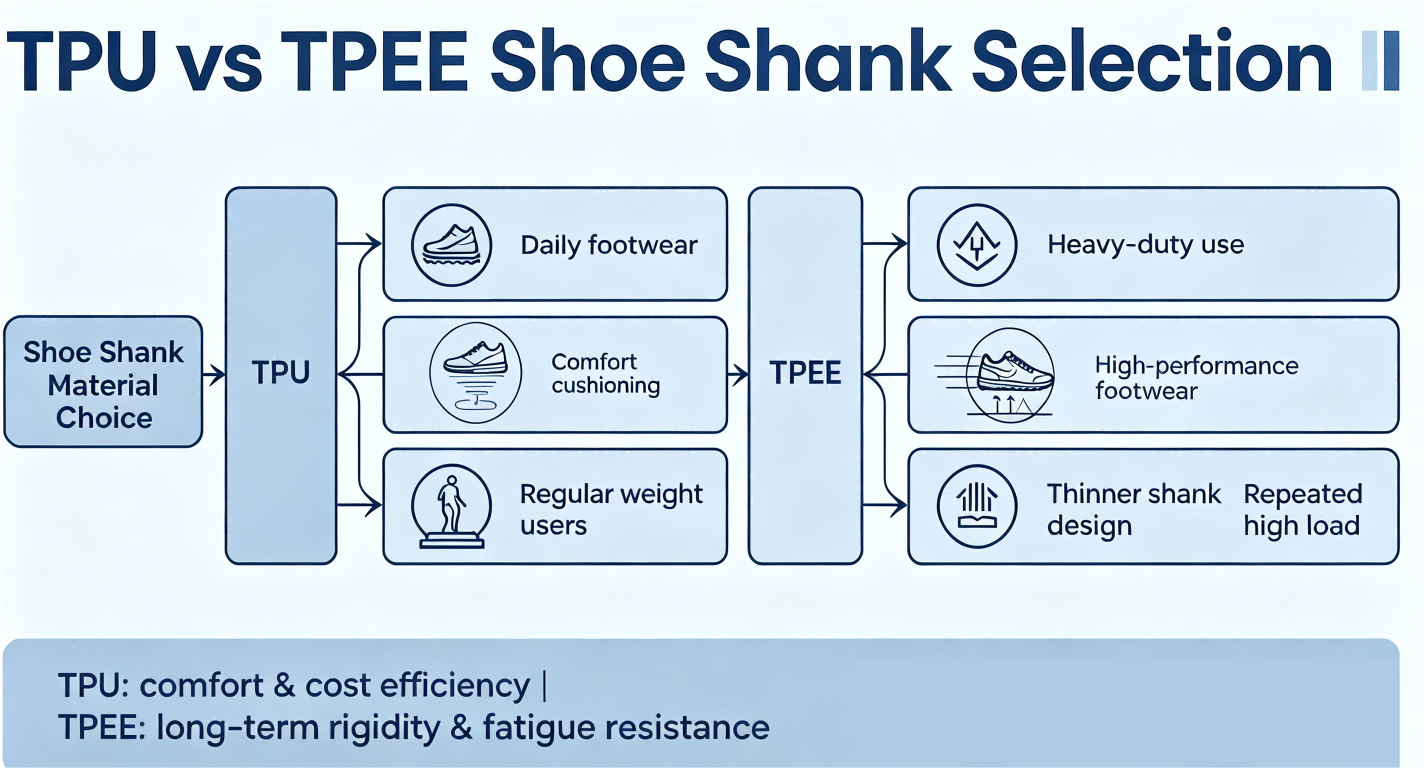
If the shank's job is comfort, everyday support, and natural flexion at typical body weights — which describes the overwhelming majority of footwear on the market — TPU is not just adequate, it's the rational choice. It delivers the rebound, the abrasion margin, and the fatigue life the application demands, at a materially lower cost, with the most forgiving and best-understood processing window in the industry.
The cases where TPEE genuinely earns its premium — extreme sustained loads, very thin high-rigidity profiles, unusually harsh thermal environments — are real, but they're a small slice of the market. And even then, the answer is often not "switch to TPEE" but "spec a higher-hardness, more fatigue-resistant TPU grade" — which is where working with a specialist manufacturer matters.
Why Brands Choose KUNSUN TPU for Shank and Support-Plate Applications
At KUNSUN POLYMER MATERIAL (FUJIAN) CO., LTD., TPU isn't one product line among many — it's our sole focus. As a Taiwan-funded manufacturer with decades of polymer expertise behind us, we build our footwear-grade TPU range specifically around the properties shanks and support plates actually need:
-
Grade-matched hardness selection across the A80–A95 / low-D range, so your shank lands exactly on your target stiffness — not "close enough."
-
Formulations engineered for low compression set, addressing the one genuine TPU weakness head-on, so your shank keeps its geometry through the shoe's entire service life.
-
Consistent lot-to-lot quality from vertically integrated production — because a shank that varies by ±3 Shore points is a fit problem waiting to happen.
-
Application engineering support: send us your part geometry, target thickness, and load expectations, and our materials engineers will recommend a grade and processing window — and can support mold trials to validate it.
We'd rather help you specify the right TPU than sell you the most expensive material. That's how long-term partnerships in this industry actually get built.
Ready to specify your shank material? Contact the KUNSUN technical team at koslen@163.com to request samples, datasheets, or a grade recommendation tailored to your design.



 IPv6 네트워크 지원